Inside AMDIS's AI Translation Platform: Enterprise Translation Without the Guesswork
Written by: AMDIS Team
Generic machine translation gets you a draft. It doesn't get you a brand name spelled correctly, an abbreviation expanded the way your industry expects, or an audit trail showing who approved what before it went live. For companies translating product content, contracts, or technical documentation at scale, that gap is where quality — and budget — gets lost.
AMDIS built its AI Translation Platform to close it: a single system that runs multiple AI engines side by side, enforces your terminology automatically, and routes every translation through a defined quality and approval workflow before it ships.
User & Role Management
Translation work involves more than translators. Reviewers, approvers, project owners, and administrators each need different access — and none of them should be able to accidentally publish unreviewed content. The platform implements fine-grained, role-based access control, so permissions for translation teams are scoped to exactly what each role needs to do.
Master Data Management
Languages, AI engines, quality rules, and text transformations are all configured centrally rather than hardcoded per project. Add a new target language, register a new AI engine, or adjust a quality rule once, and it's available across every project that needs it — no duplicated configuration, no drift between teams.
Translation Memory
Brand names shouldn't get "translated." Abbreviations shouldn't get expanded incorrectly. The platform's translation memory layer maintains dictionaries, brand names, abbreviations, and synonyms, and automatically tags every matched term in both source and output text.
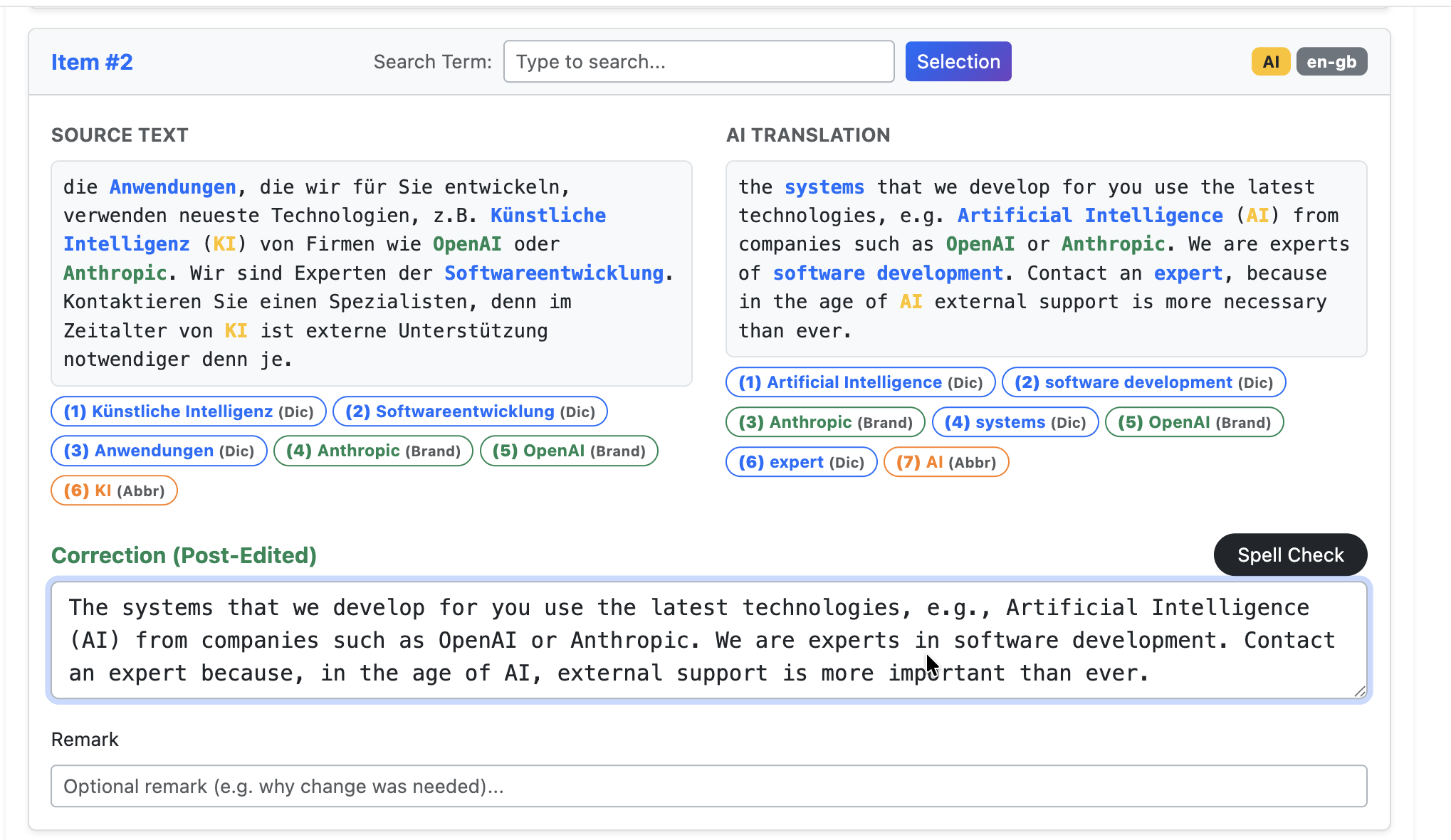
Matched terms are tagged by type — dictionary, brand, abbreviation — directly against the source and AI output, with a side-by-side correction field for human post-editing.
That visibility is what makes post-editing fast: a reviewer can see exactly which terms came from the controlled vocabulary versus the AI's general output, and correct only what needs correcting.
AI Translation Engines
No single AI engine is the right answer for every language pair or domain. The platform supports multiple providers — Ollama, OpenAI, Anthropic, Google AI, and custom engines — and lets you run them in parallel for direct comparison.
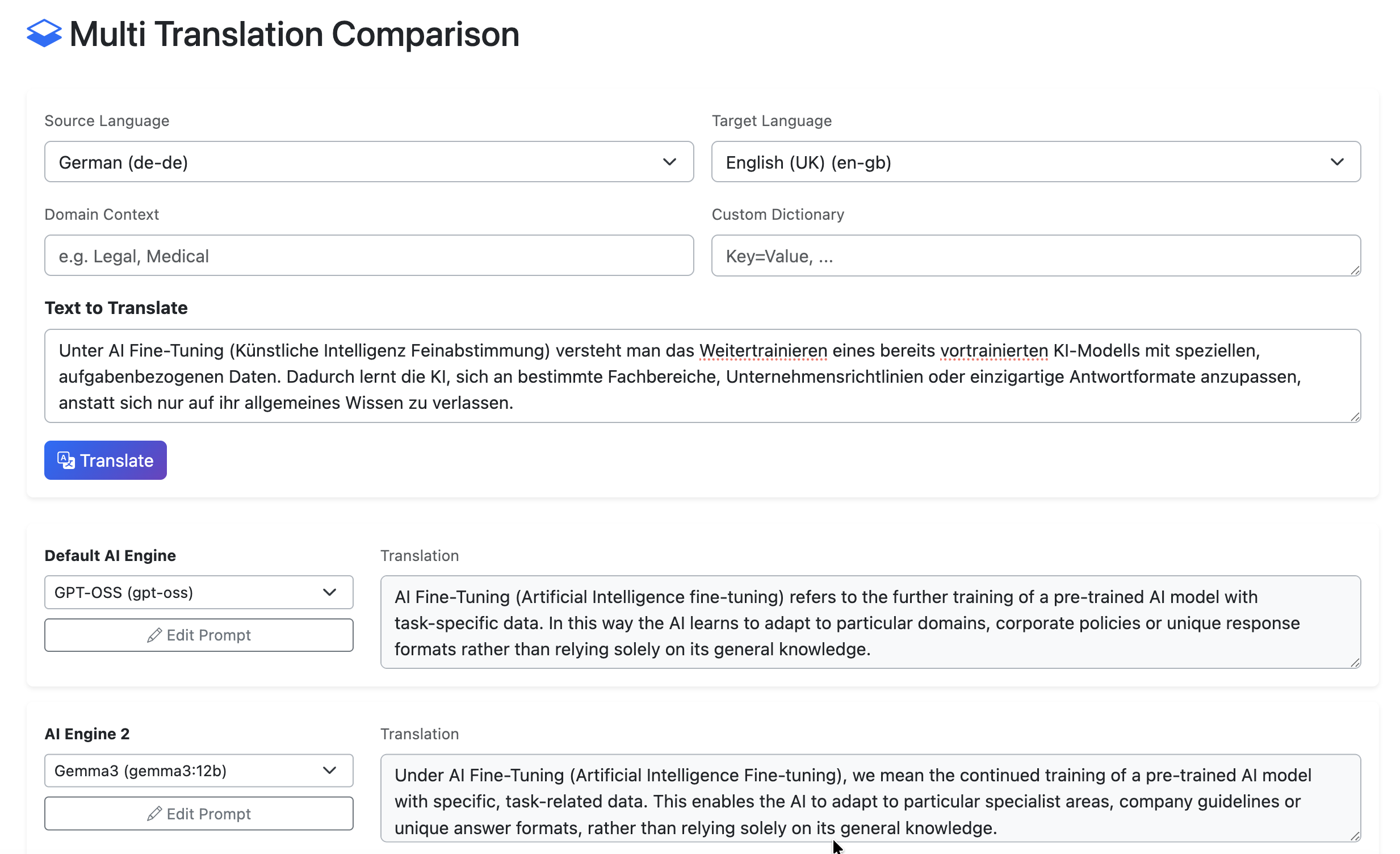
The same source text translated by two different engines (GPT-OSS and Gemma3 in this example), with editable prompts per engine, displayed side by side for direct quality comparison.
This turns "which AI engine should we use for German legal text?" from a guess into a measurable decision — and the answer can differ by language pair, domain, or even individual project.
Quality Control
Translation quality isn't a feeling — it's a set of rules. The platform applies configurable data quality rules with fail, warning, or pass outcomes, catching issues like missing terminology, format violations, or untranslated segments before content reaches a human reviewer or, worse, a customer.
Project / Workflow Management
Every translation moves through a defined, traceable pipeline: source ingestion and review, automated DQ checks, preprocessing, AI translation, postprocessing, target-side DQ validation, human post-editing, and final approval before export.
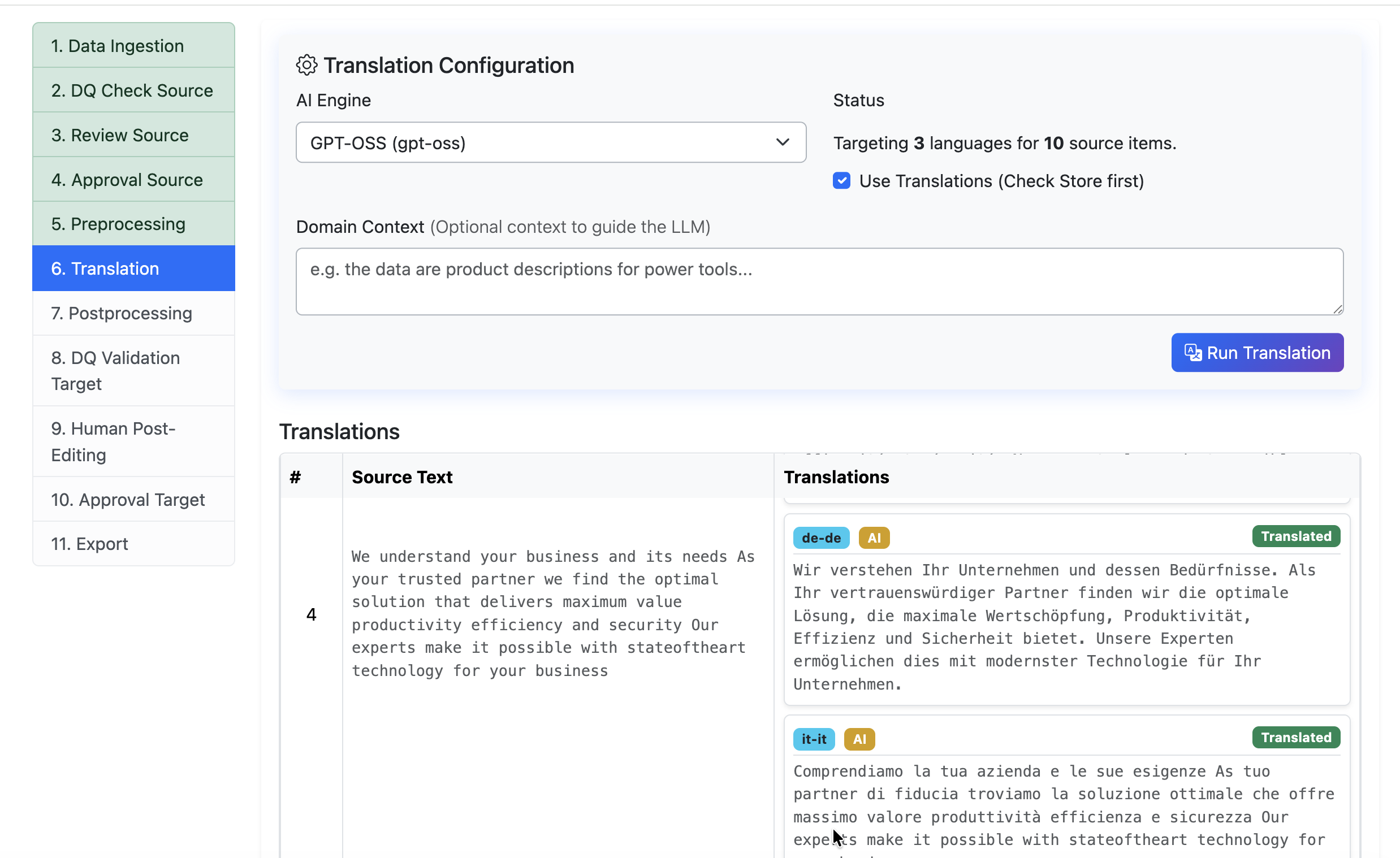
Each project moves through a fixed set of stages — including dedicated DQ checks on both source and target content — so nothing reaches export without passing the gates your team defines.
Project owners get a single view of where every item stands, across however many target languages a project requires, without chasing status updates across spreadsheets and email threads.
Built for Teams That Take Translation Seriously
Speed from AI, accuracy from rules, and accountability from a real workflow — that's the combination most translation tools skip. AMDIS's AI Translation Platform is built for organizations where a mistranslated brand name or an unreviewed contract clause isn't a minor inconvenience.
Want to see it on your own content? Get in touch with AMDIS to arrange a walkthrough.