Document Intelligence: From PDF Data to Business Value
Written by: AMDIS Team
A signed contract is a PDF. What's actually in it — the notice period, the governing law, the renewal clause, the tax ID buried in paragraph twelve — stays locked inside that PDF until someone reads it. At scale, across hundreds of scanned contracts in multiple languages, "someone reads it" stops being a plan.
AMDIS's LaTraM platform turns that PDF into queryable, verified data: OCR and translation get the text out, a configurable extraction schema defines what matters, AI does the reading, and every extracted fact carries its own evidence back to the source — so nothing is asserted without proof.
From Scan to Structured Text
A working document goes in as a PDF or image. LaTraM runs OCR with AI, detects the source language per document or per page, and extracts the text — then translates it into the target language you need, with the source and translated text shown side by side for direct comparison.
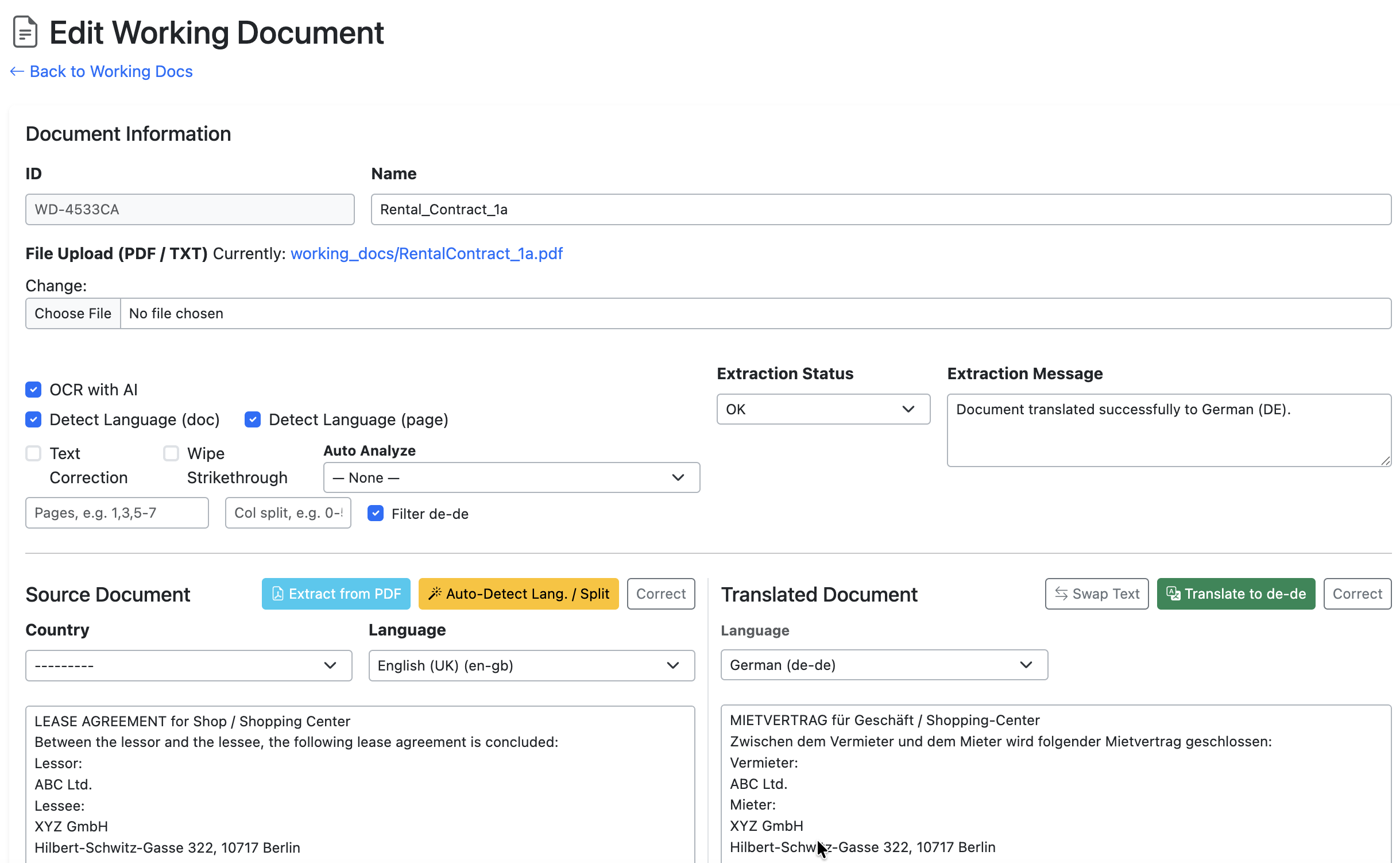
Source and translated text sit side by side, each with its own correction control, so a reviewer can fix the OCR or the translation independently without losing the original.
Both sides stay editable. If the OCR misread a character or the translation needs a domain-specific term, a reviewer corrects it in place — the correction becomes part of the record, not a one-off fix.
Defining What to Extract
Before any AI reads a contract, you define what you're looking for. A clause category specifies its value type — date, boolean, free text, currency, a constrained value list — and whether the analysis needs a supporting quote, a confidence score, or a judged assessment.
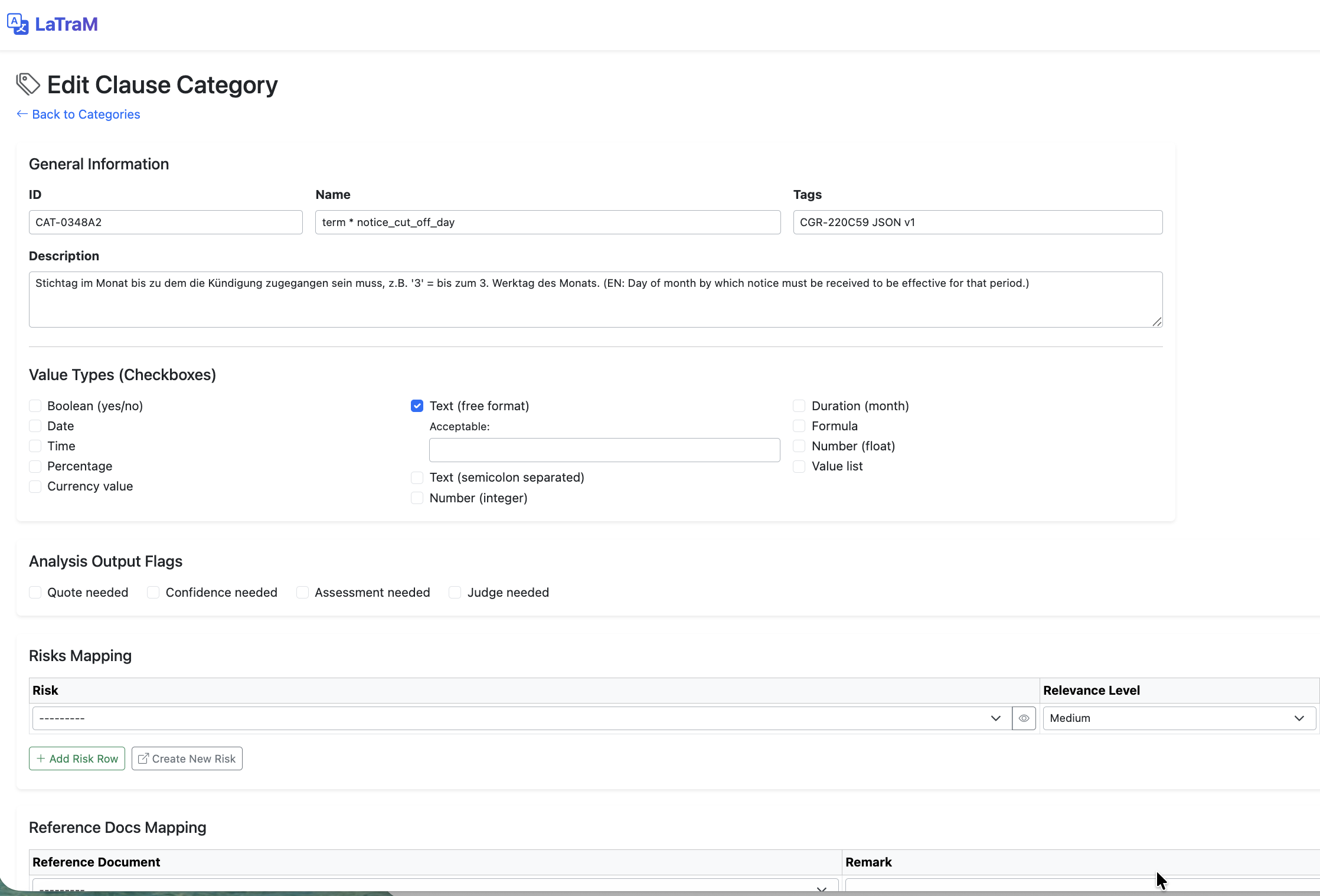
Each category — here, the notice-period cut-off day — is mapped to value type, required output flags, and one or more risks with a relevance level, plus reference documents the AI can cite against.
Categories also map directly to risks, with a relevance level (low/medium/high), and to reference documents — statutes, internal policy, prior case law — that ground the AI's interpretation in something more authoritative than its own training data.
AI-Powered Analysis, With Built-In Verification
Running an analysis applies every defined category to a document and produces a value, an explanation, and — where a quote is required — a verification step that checks the extracted value against the source text directly.
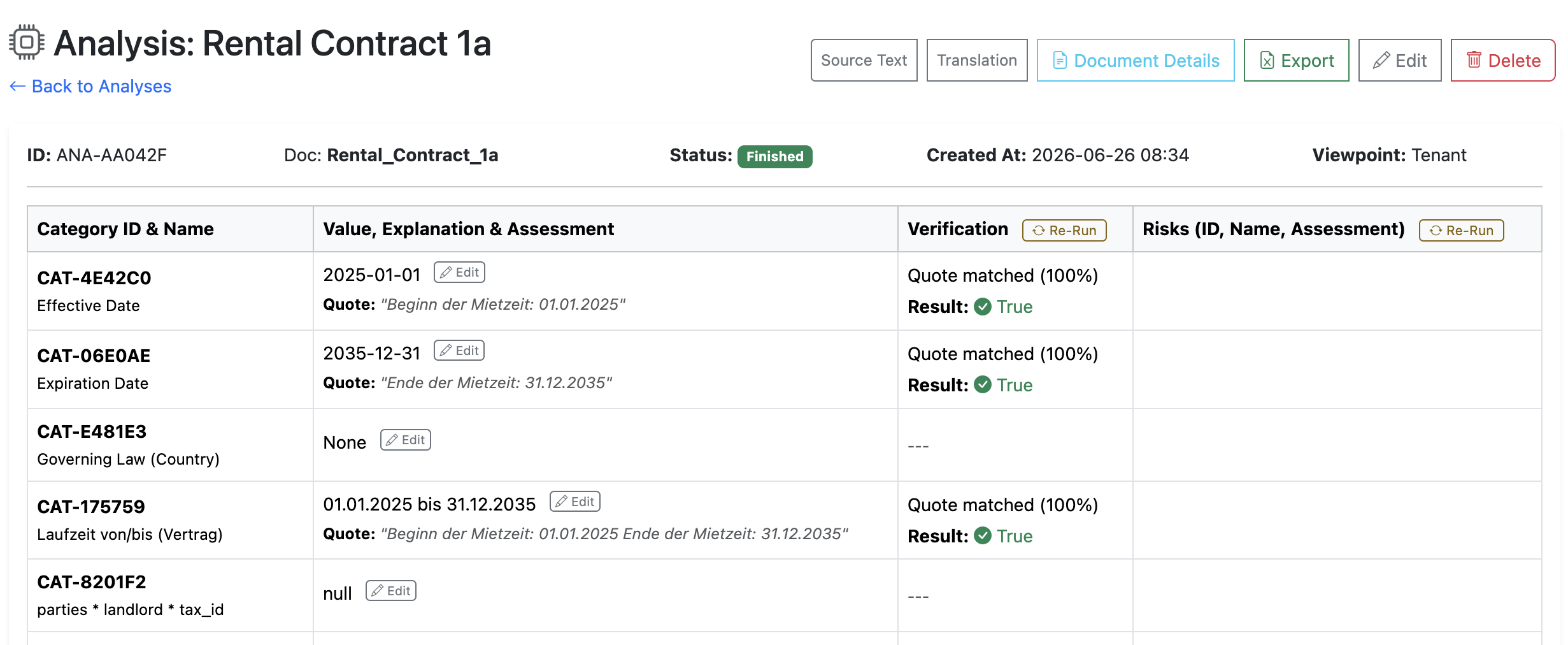
Every row pairs an extracted value with a quote match check (here, 100%) against the source — making it obvious where the AI is grounded in the text and where a human still needs to look.
When a quote matches, you get a confirmed True result and can move on. When it doesn't — or when no quote applies, as with derived or null values — that's the signal for human assessment rather than blind acceptance. Categories and the verification logic itself can be re-run independently as your extraction rules improve.
From Facts to Answers
Extracted facts don't stay locked in a single document view — they land in a relational database, grouped by category set (a "Rental Agreements: Basic" group, for example), ready for both structured export and ad-hoc querying.
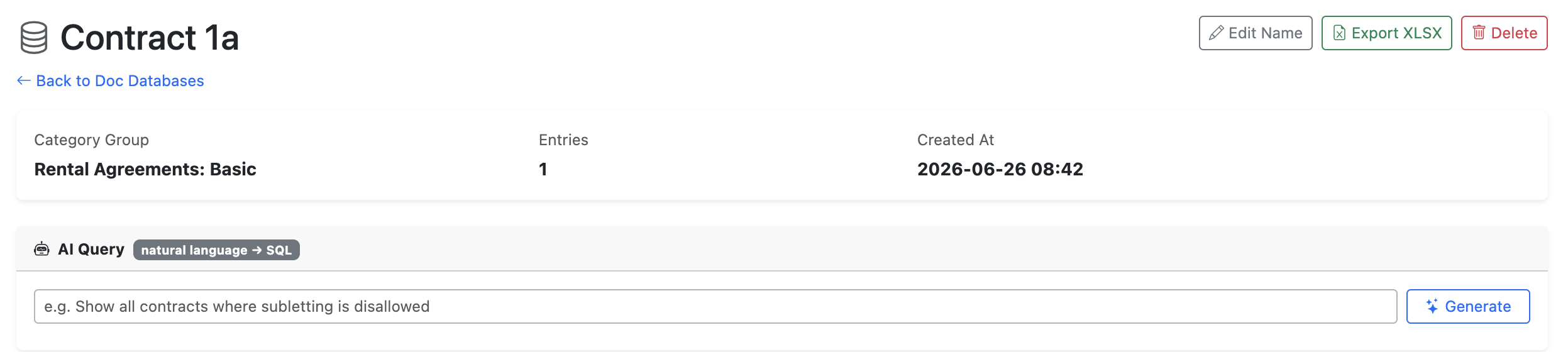
Instead of writing SQL or filtering exports by hand, an AI query box turns a plain-language question — like finding contracts where subletting is disallowed — directly into a database query.
That's the payoff of the whole pipeline: a question like "which contracts disallow subletting" stops being a manual document review and becomes a query — answered in seconds, against data with a traceable path back to the original PDF.
Built for Documents That Need to Be Right
OCR and AI extraction get you speed. Quote verification, risk mapping, and human assessment get you the part speed alone can't provide: confidence that what's in the database actually matches what's in the contract.
Want to see LaTraM on your own document set? Get in touch with AMDIS to arrange a walkthrough.